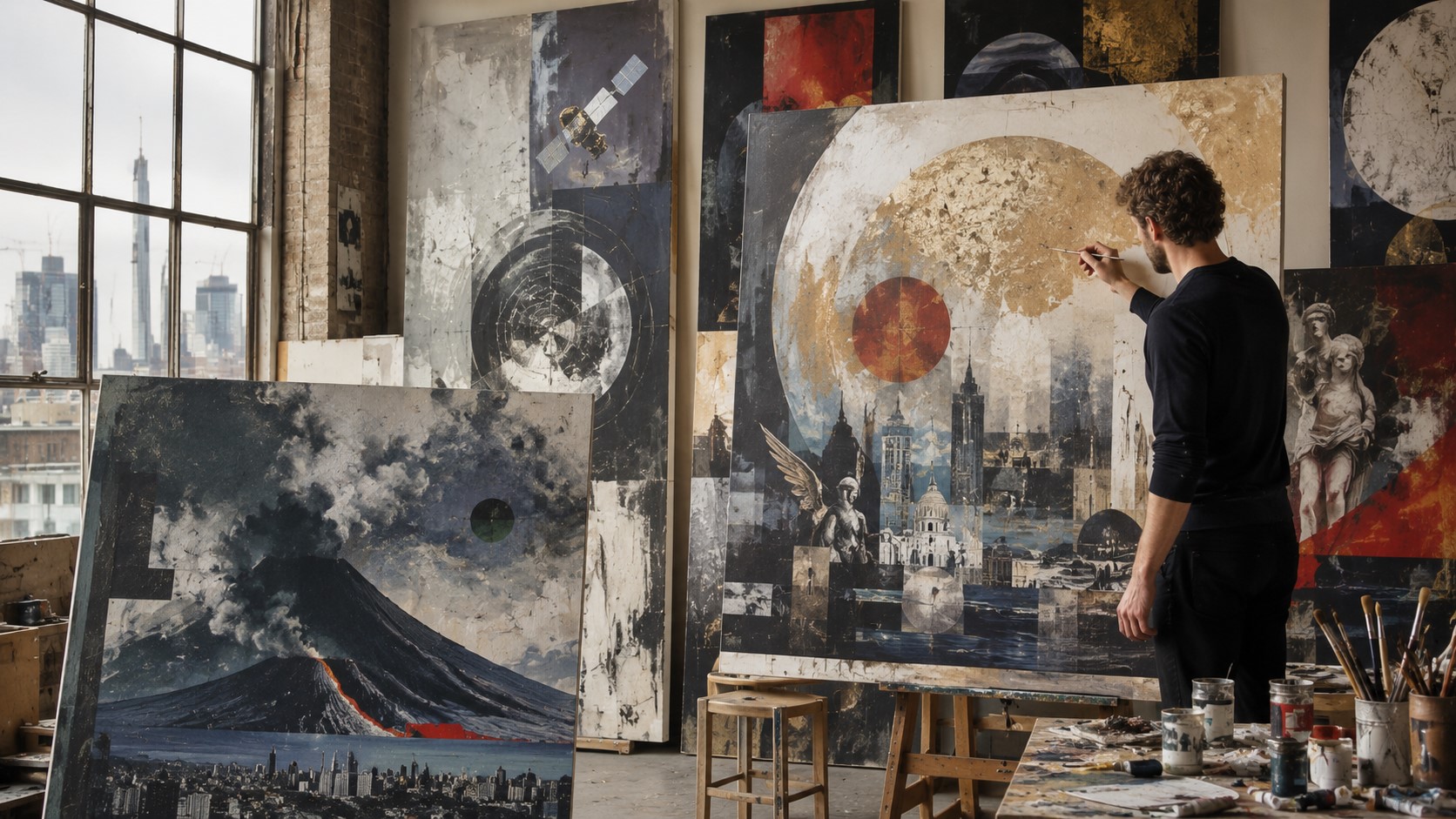
From nuclear submarines and volcanic landscapes to satellite networks and ancient myths, artist Caragh Thuring is challenging audiences to rethink how seemingly unrelated events shape the modern world.
The London-based painter has built a reputation for creating richly layered artworks that blend history, politics, science, technology and personal memory into visually complex narratives.
In a new body of work, Thuring brings together powerful symbols of conflict, environmental change, technological expansion and cultural history. Military aircraft appear alongside medieval imagery, while satellites orbiting Earth share space with references to mythology, religion and everyday life.
Rather than offering direct explanations, Thuring encourages viewers to make their own connections. Her paintings often combine contrasting themes, creating thought-provoking scenes that explore uncertainty, transformation and the fragile balance between progress and destruction.
One of the recurring influences in her work comes from her childhood in Scotland, where she witnessed nuclear submarines moving through coastal waters and industrial structures being transported to offshore energy projects. These early experiences continue to shape her fascination with power, technology and humanity's relationship with the environment.
Another major theme is the growing influence of modern technology. In recent works, Thuring references vast satellite networks orbiting Earth, exploring how digital infrastructure is reshaping daily life while transforming humanity's relationship with the natural world.
Her paintings move between intimate domestic spaces and global events, linking ordinary moments with broader social, political and environmental questions. This approach has earned praise from critics who view her work as both visually ambitious and intellectually engaging.
Rather than delivering simple messages, Thuring sees art as a catalyst for curiosity. She believes paintings should spark new ways of thinking rather than provide easy answers.
The result is a collection of works that reflect many of the defining issues of the modern era — conflict, technology, environmental uncertainty, cultural identity and the search for meaning in an increasingly complex world.
As contemporary art continues to engage with global challenges, Thuring's work stands out for its ability to connect personal experience with wider historical and political narratives, inviting audiences to explore the hidden links that shape modern life.
UKEcho News brings you accurate, independent reporting from across the UK and beyond.
Comments (0)
Sign in to join the discussion.
Be the first to comment.