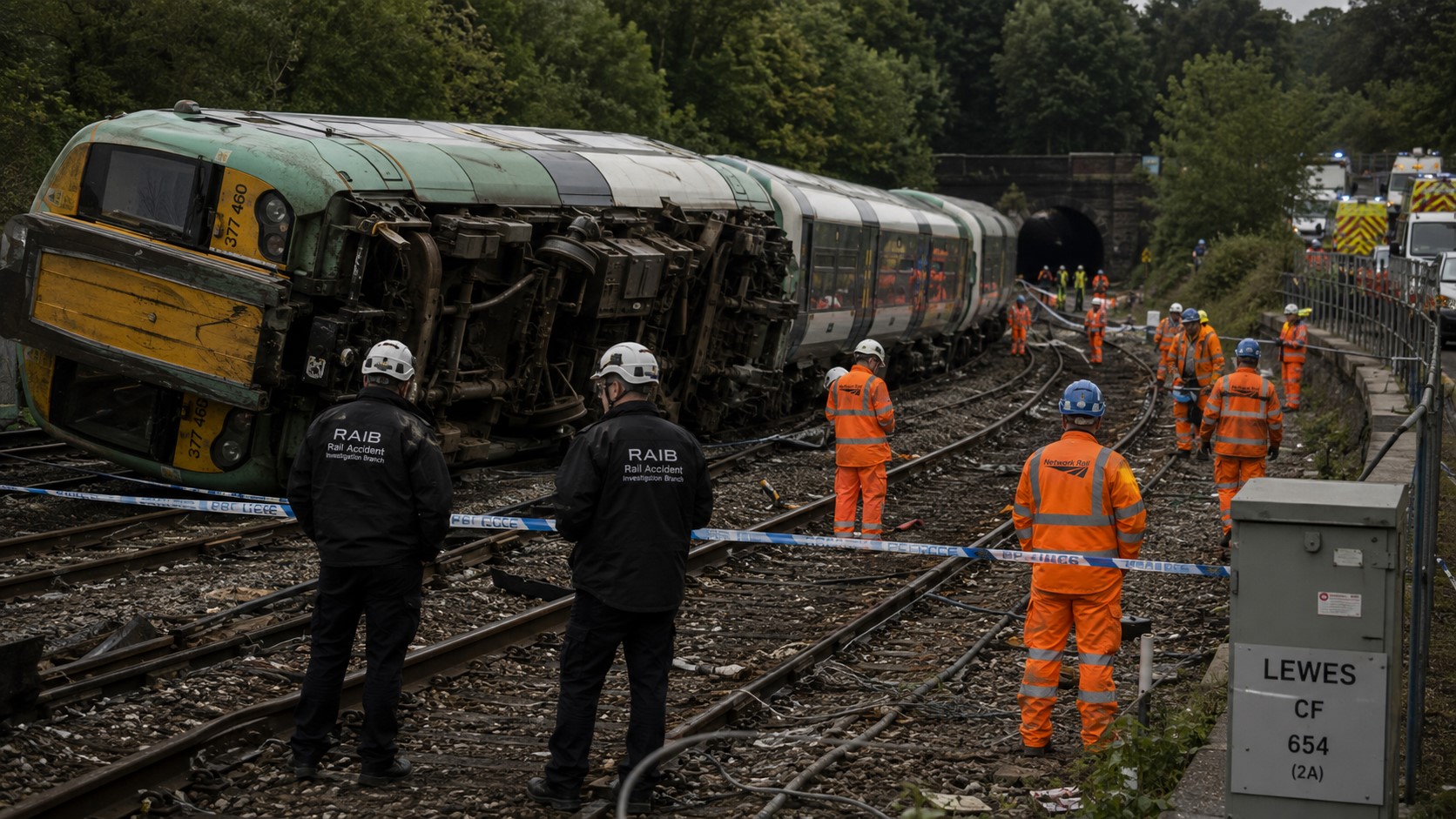
Pre-Existing Track Defect Found Before Serious Lewes Train Derailment
LEWES — Investigators have found that a track defect existed before the serious Southern train derailment near Lewes, raising fresh questions about railway safety and infrastructure monitoring in Britain.
The Rail Accident Investigation Branch (RAIB) said an interim investigation had identified irregularities in the track before the 13 August derailment in East Sussex. CCTV footage showed evidence of a track defect before the train came off the rails.
The Southern service was travelling at around 65mph with approximately 150 people on board when three carriages overturned. Thirty people were injured, with 20 requiring hospital treatment, according to the investigation findings.
The discovery has intensified scrutiny of railway infrastructure during periods of extreme summer temperatures.
Investigators believe high temperatures and track buckling may have contributed to the incident. The affected railway runs across a clay embankment, where changes in moisture can also affect ground conditions.
Network Rail and Greater Thameslink Railway have apologised for the disruption and said passenger safety remains their priority.
The route is expected to remain closed until at least 26 August, causing continuing disruption for passengers travelling through the Lewes area.
Another derailment occurred less than 24 hours later near Wickford in Essex, although no injuries were reported in that incident. Investigations into both events are continuing.
The Lewes investigation could have wider implications for how Britain's rail network monitors tracks during increasingly challenging summer weather.
The RAIB's interim findings do not yet establish the full cause of the derailment. A final investigation is expected to take considerably longer.
For passengers and railway operators, the incident highlights the importance of early detection of infrastructure defects, particularly when extreme temperatures can place additional stress on tracks.
The investigation will now focus on why the defect developed, how it was detected and whether earlier action could have prevented the derailment.
UKEcho News brings you accurate, independent reporting from across the UK and beyond.
Comments (0)
Sign in to join the discussion.
Be the first to comment.