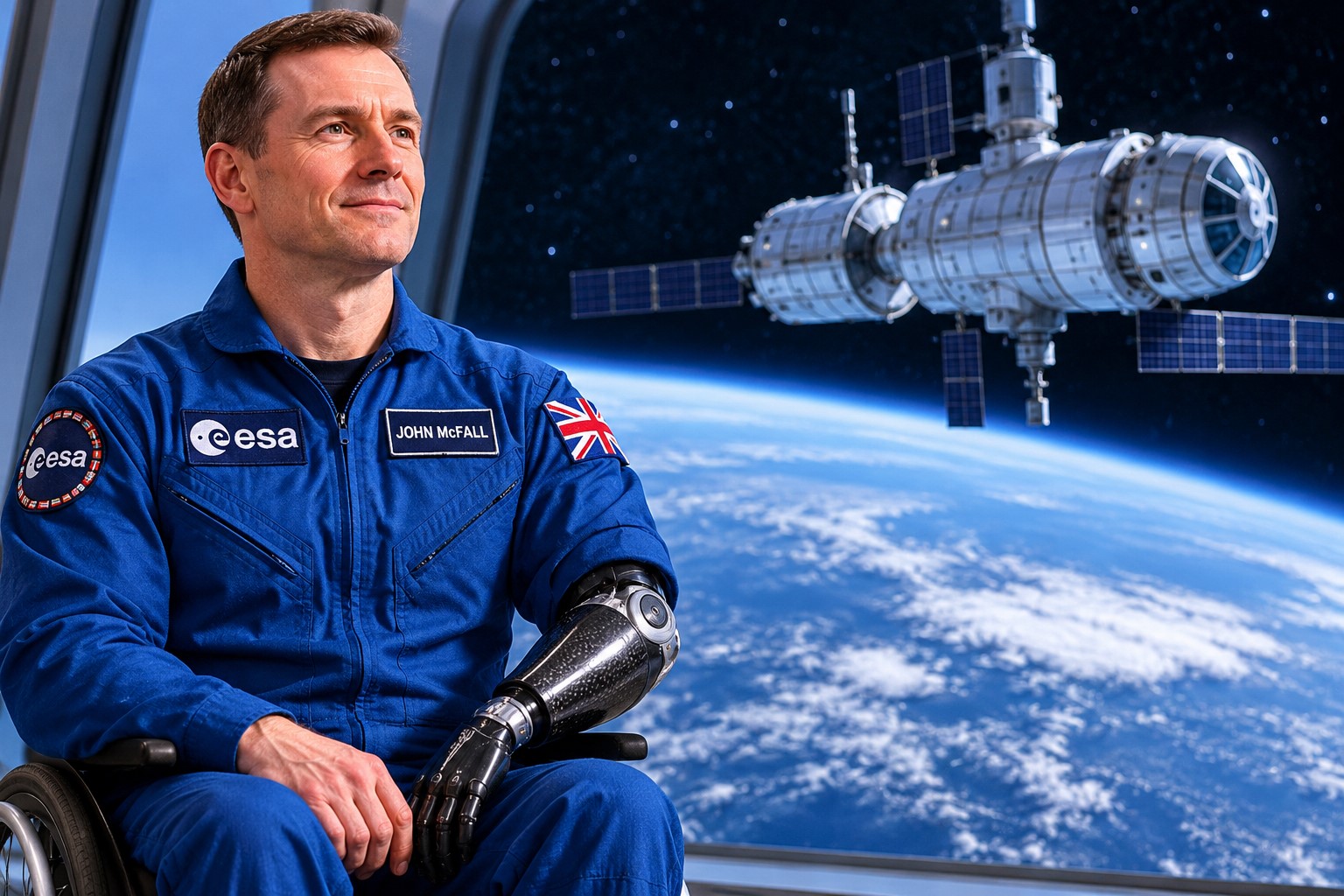
A British Paralympian and surgeon could soon make history by becoming the first person with a physical disability to live and work in orbit, marking a major step forward for accessibility and inclusion in space exploration.
John McFall, a member of the European Space Agency’s astronaut reserve, was cleared for orbital activities last year and is now being considered for a future mission aboard the Haven-1 commercial space station. The mission could take place shortly after the station’s planned launch in 2027.
Developed by California-based startup Vast, Haven-1 is designed as a compact commercial space station capable of accommodating up to four astronauts. The facility will include research space for microgravity experiments, observation areas for viewing Earth, and living quarters for short-duration missions.
McFall’s planned mission would focus heavily on scientific research, particularly examining how space environments affect both the human body and advanced prosthetic technology. Researchers hope the findings could improve the design of lighter, more adaptable prosthetics while also expanding understanding of muscle loss, bone health, and rehabilitation techniques.
Beyond the scientific goals, the mission represents an important moment for representation within the space industry. McFall has emphasized that expanding access to space exploration is about challenging outdated assumptions and demonstrating that physical disabilities do not limit a person’s ability to contribute to complex scientific missions.
If approved, the mission would not only mark a milestone in astronaut history but could also influence future approaches to accessibility, research, and diversity in human spaceflight.
UKEcho News brings you accurate, independent reporting from across the UK and beyond.
Comments (0)
Sign in to join the discussion.
Be the first to comment.