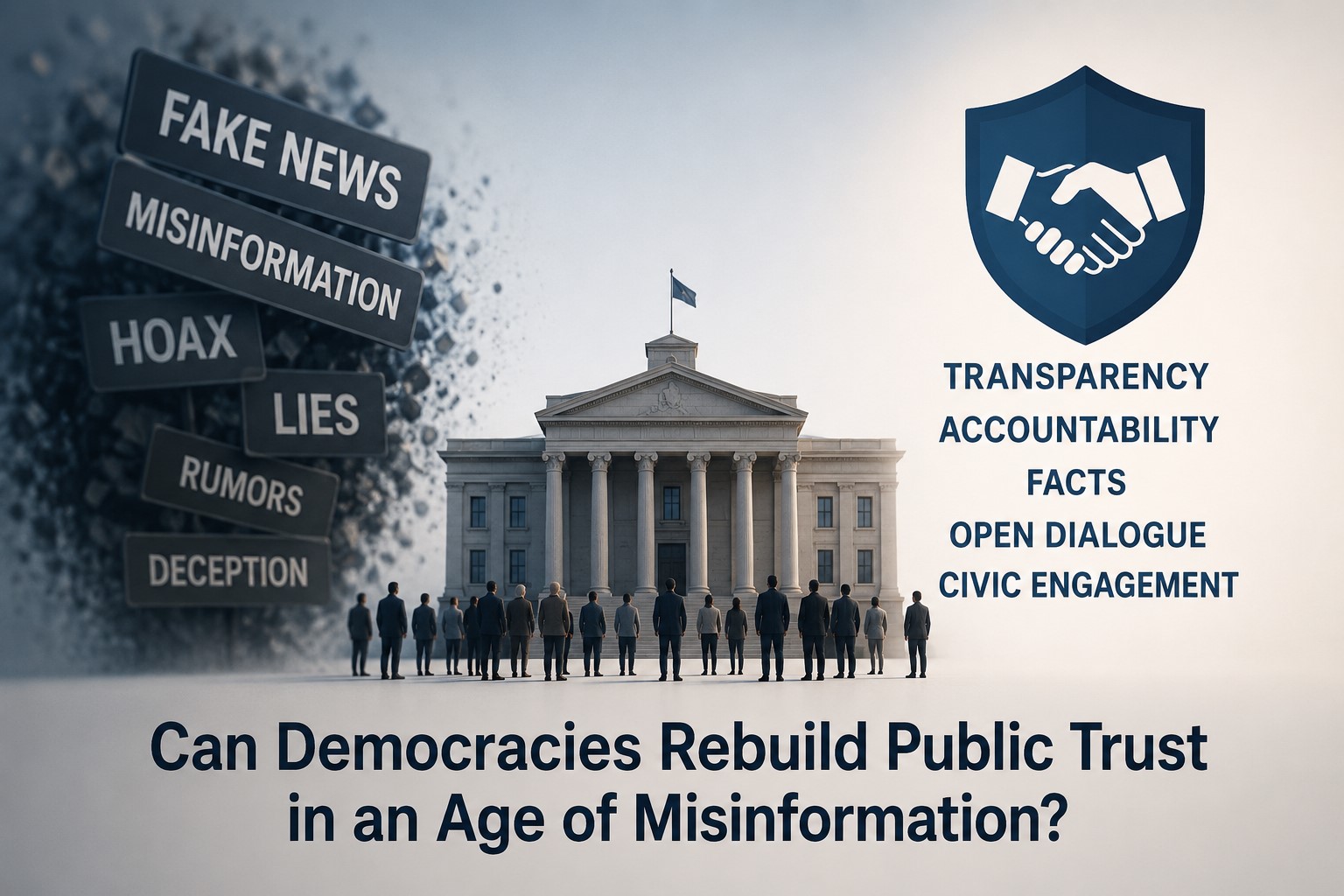
Can Democracies Rebuild Public Trust in an Age of Misinformation?
Public trust has always been one of the foundations of a healthy democracy. Citizens rely on governments, institutions, media organizations, and public officials to provide accurate information and act in the public interest. Yet in recent years, trust has become increasingly fragile as misinformation spreads rapidly across digital platforms and political divisions deepen.
The rise of social media has transformed how people consume information. News now travels instantly across the globe, often reaching millions of people before facts can be verified. While this has increased access to information, it has also created an environment where rumors, misleading claims, and false narratives can spread at unprecedented speed.
Misinformation is not a new phenomenon, but technology has amplified its reach and impact. Deepfake videos, manipulated images, anonymous accounts, and algorithm-driven content can blur the line between fact and fiction. As a result, many people struggle to determine which sources are trustworthy and which are designed to mislead.
The consequences extend far beyond online debates. Misinformation can influence elections, shape public opinion, undermine confidence in institutions, and create divisions within communities. In some cases, false information can even affect public health, national security, and economic stability.
Rebuilding trust requires action from multiple sectors of society. Governments must improve transparency and communicate more effectively with citizens. Public institutions need to demonstrate accountability and ensure that decisions are made openly and fairly. At the same time, media organizations must continue to uphold high standards of accuracy, fact-checking, and responsible journalism.
Technology companies also have an important role to play. Social media platforms have become central to public discourse, yet they face growing pressure to address harmful misinformation while protecting freedom of expression. Finding the right balance remains one of the defining challenges of the digital age.
Education is another critical part of the solution. Media literacy and critical thinking skills can help people evaluate information more carefully and identify unreliable sources. In a world saturated with content, the ability to distinguish facts from opinions has become an essential civic skill.
Citizens themselves also share responsibility. Healthy democracies depend on informed participation, respectful debate, and a willingness to engage with differing viewpoints. Trust cannot be restored solely through policy changes; it must also be rebuilt through stronger civic engagement and a shared commitment to truth.
Despite the challenges, there are reasons for optimism. Around the world, journalists, educators, researchers, and community leaders are developing new tools and strategies to combat misinformation and strengthen public understanding. Advances in fact-checking technology and digital verification methods are also helping to identify false content more quickly.
UKEcho News brings you accurate, independent reporting from across the UK and beyond.
Comments (0)
Sign in to join the discussion.
Be the first to comment.