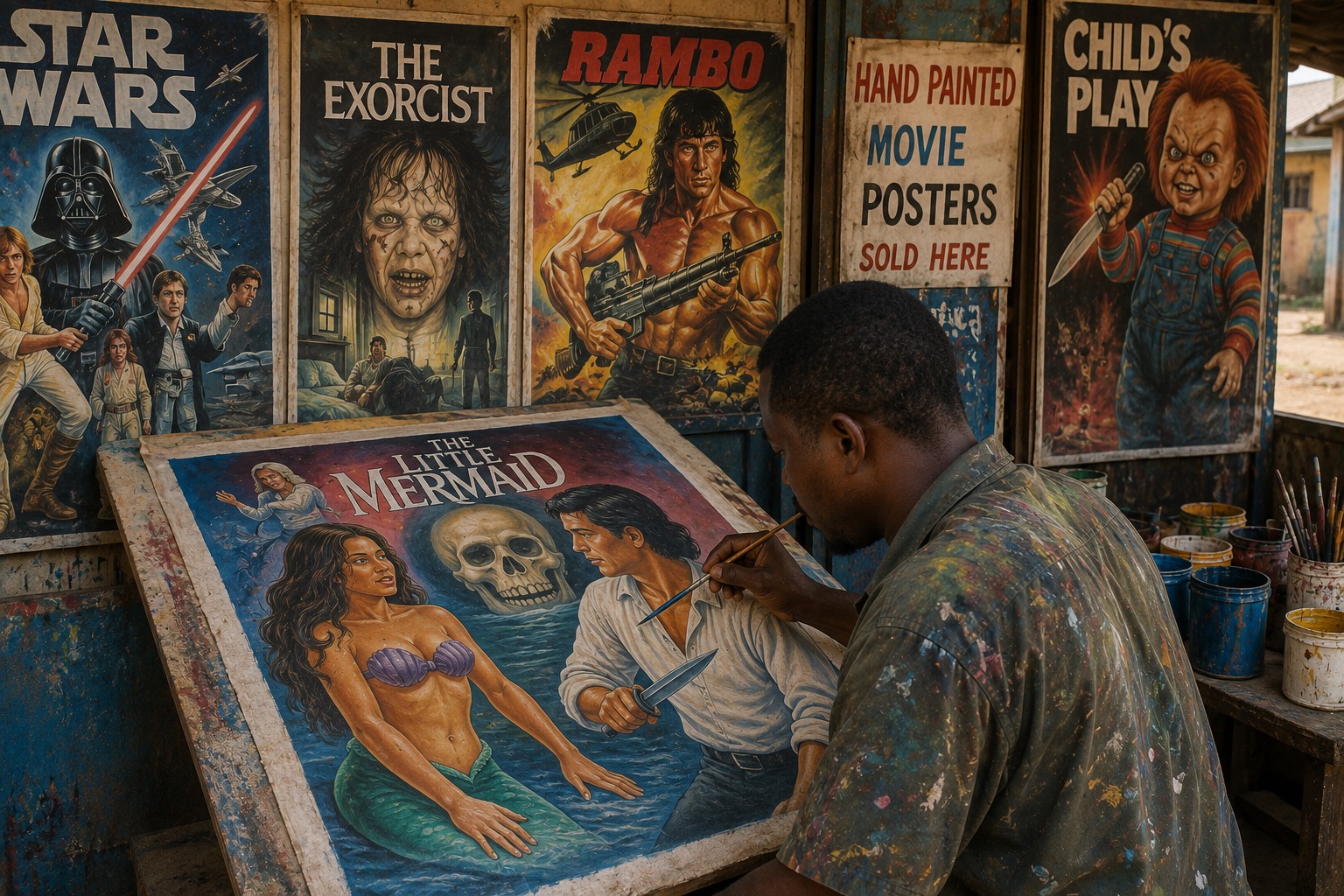
On a porch in Teshie, near Accra, artist Jeaurs Affutu better known as Heavy J carefully works on a new film poster. His canvas is an ordinary flour sack, but the image taking shape is anything but ordinary.
The poster is for The Little Mermaid. Yet Affutu’s version features a knife-wielding Prince Eric and a skull in the background details that do not appear in the familiar fairy tale.
For Heavy J, accuracy is not the point.
“We add more to make people interested,” he says.
That approach captures the spirit of Ghana’s remarkable tradition of hand-painted film posters, an art form that transformed familiar movies into vivid, often surreal and highly exaggerated works of visual storytelling.
The tradition emerged in the late 1970s and continued into the early 2000s, when local video clubs began commissioning artists to create their own posters. The original promotional materials supplied by film distributors often failed to attract enough viewers, so artists developed a more dramatic alternative.
Film plots became starting points rather than strict instructions. Artists added monsters, weapons, blood, bizarre characters and scenes that had little or no connection to the actual movie. Different artists and video clubs competed to create the most eye-catching interpretation.
The result was a unique form of popular art—part advertisement, part fantasy and part creative reinvention.
The tradition began to decline as access to electricity, televisions and home video equipment expanded across Ghana. As more people watched films at home, many video clubs disappeared and artists moved on to other forms of work.
By then, however, Ghana’s film posters had attracted international attention. Books, exhibitions and collectors helped transform the once-practical advertising materials into sought-after pieces of art. Rare original posters began commanding increasingly high prices.
Interest in newly commissioned posters has also returned in recent years, helped by online marketing and growing demand from film enthusiasts, particularly in the United States and other Western markets.
One organisation helping to keep the tradition alive is Deadly Prey Gallery, founded in 2012 by Ghanaian collector Robert Kofi and Chicago-based Brian Chankin. Kofi first encountered the world of Ghanaian film posters as a child, working as a hype man at video centres in Winneba. He later became a collector and seller before establishing the gallery.
Today, Deadly Prey Gallery works with around 15 artists, including Heavy J, connecting them with international customers and arranging commissions that are shipped once completed.
Demand is strongest for classic action, horror and science-fiction films. Posters inspired by The Exorcist, Star Wars and The Terminator franchises are among the popular choices. Commissioned works can begin at around $600.
Kofi plays an important role in the creative process. He helps match films with artists, discusses the concept for each poster and regularly visits studios to review works in progress.
At a studio in Ashaiman, artist Benjamin Amartey—known as Stoger—works on posters for Poltergeist and Gummo. His interpretations are designed to intensify the most unusual or disturbing elements of a film.
For a Gummo poster, the image includes cats and a man sitting in a bathtub with a plate of spaghetti. Kofi encouraged Stoger to make the scene even more grotesque and exaggerated.
Stoger began his career as a sculptor before turning to film poster painting in the early 1990s. He says imagination is central to his work, with the goal of creating images that immediately attract attention.
That emphasis on exaggeration is rooted in a broader African tradition of using art to visualise what cannot easily be seen, according to Joseph Oduro-Frimpong, director of the Centre of African Popular Culture at Ashesi University and a collector of the posters.
Because audiences often had not seen the films being advertised, artists were free to create dramatic scenes based on imagination rather than accuracy. Sensational images were intended to spark curiosity and draw crowds.
Sometimes, however, the strategy went too far.
UKEcho News brings you accurate, independent reporting from across the UK and beyond.
Comments (0)
Sign in to join the discussion.
Be the first to comment.